
What counts as wearable technology in football?
Wearable technology is equipment attached to or worn by a player to collect performance or physiological information. In football, it is often discussed as part of the wider Electronic Performance and Tracking Systems (EPTS) ecosystem. FIFA describes EPTS as including camera-based and wearable technologies used to track player and ball positions. These systems can also be combined with accelerometers, gyroscopes and heart-rate monitors to measure workload and physiological parameters.
It is useful to separate wearable tracking from camera-based tracking. A camera system can track player locations without the player wearing a device. A GPS or GNSS pod travels with the player, usually in a fitted vest. A local positioning system uses fixed antennas or receivers around a pitch or indoor facility. These technologies can complement one another, but their measurements are not automatically interchangeable.
FIFA’s overview of Electronic Performance and Tracking Systems outlines the advantages and limitations of optical camera systems, local positioning systems and GPS/GNSS. For example, cameras are non-invasive and can support ball tracking, but occlusions can require correction. GNSS units can collect many measurements and are quick to deploy, but signal visibility and measurement accuracy can be concerns.
The main wearable technologies used in football
1. GPS and GNSS tracking vests
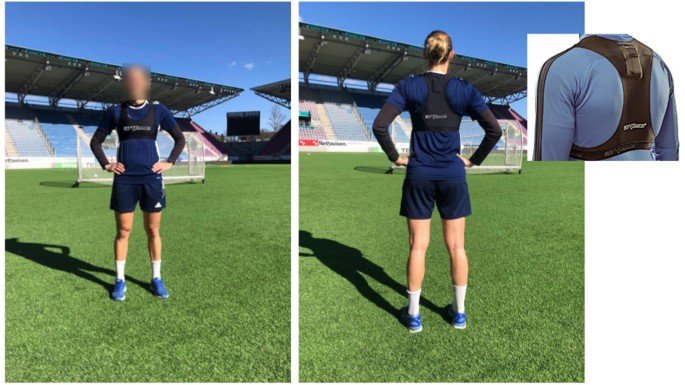
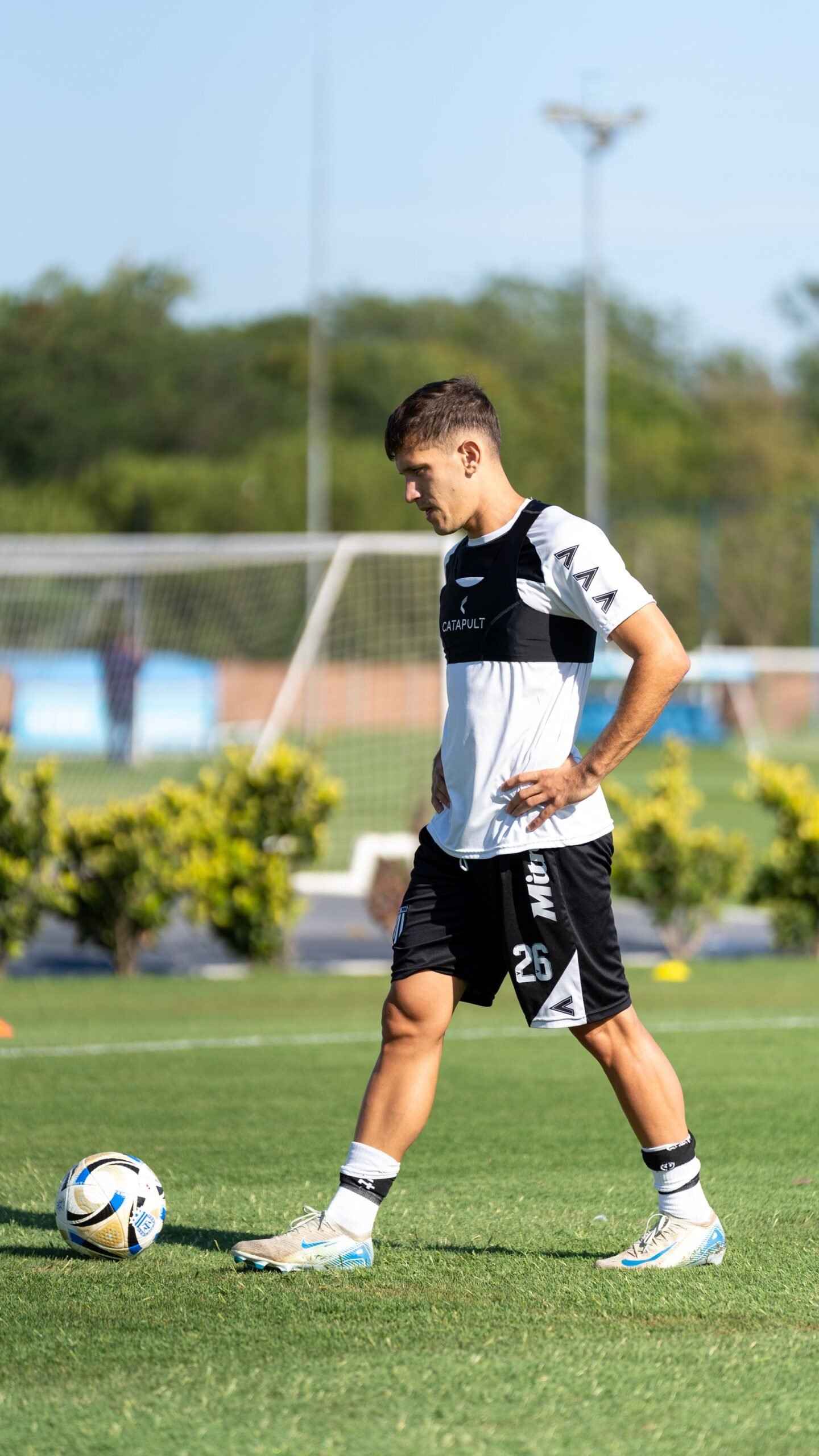
A small unit is commonly held in a fitted vest between a player’s shoulder blades. Depending on the unit and software, it can record position and movement over time, allowing the performance team to estimate total distance, speed bands, high-speed running, sprint activity and other running-based measures. Some systems combine satellite positioning with inertial sensors.
These are particularly useful in outdoor training and match preparation, where the staff want to compare the physical demands of a drill, session or match. They can help reveal when a substitute has received much less match exposure than a starter, or when a player has completed a session with a different workload from the rest of the group.
2. Inertial measurement units (IMUs)
Accelerometers and gyroscopes measure changes in acceleration and orientation. In football, IMUs are often integrated into tracking pods, but they can also be positioned on the body or foot. They can help estimate rapid changes in movement, impacts, jumps and other mechanical-load indicators.
Foot-mounted IMUs are especially interesting because they can capture aspects of foot movement and contact that a vest cannot directly observe. Depending on the device and validated algorithm, they may support analysis of technical actions such as foot contacts, kicking or running mechanics. They do not automatically understand whether a pass was tactically correct or whether a player made the best decision.
3. Heart-rate monitors
Heart-rate straps and compatible wearable sensors help measure internal response. Two players can complete the same running drill but show different heart-rate responses because of fitness, fatigue, heat, hydration, stress or individual physiology. This is why heart rate is most useful when considered alongside external workload and player feedback.
4. Foot-mounted sensors and smart insoles
Foot-mounted systems can provide a different view of the game by focusing on the player’s interaction with the ground and ball. In research and product development, they have been explored for tracking technical and tactical characteristics. A key challenge is turning a raw movement signal into a reliable event such as a pass, shot, touch or change of direction, then validating that event in real football contexts.
5. Camera and local-position systems as supporting technology
Although these are not wearables, camera tracking and local positioning frequently appear in the same performance environment. They may help provide tactical and positional context that a wearable alone cannot supply. A club can compare tracking data with video to understand not only how far a player moved, but what was happening in the game when that movement occurred.
What does the data actually tell a football coach?
Two broad groups of measures are particularly important:
- External load: the work completed by the player, such as total distance, high-speed running, sprint distance, accelerations, decelerations and inertial load.
- Internal load: the player’s response to that work, including heart-rate response, session rating of perceived exertion, wellness reports and recovery feedback.
Neither group should be read in isolation. External load describes the task. Internal load helps reveal how demanding that task felt for the individual player. Position, playing style, session design, time played, previous training exposure and the player’s health all affect interpretation.
For example, a full-back may accumulate repeated high-speed efforts because of overlapping runs, while a centre-back may cover less high-speed distance but make frequent short accelerations and decelerations. A single distance total does not describe both jobs equally well. The data needs to be interpreted within the player’s role and the tactical plan.
Four real-world case studies
Case study 1: Club Brugge and the combination of GPS pods and heart-rate monitoring
In a case study published by tracking-system provider STATSports on 25 February 2025, Club Brugge physical performance coach Eddie Rob described how the club combines GPS pods with heart-rate monitors to assess both external and internal load.
The case describes a live data feed during training. Staff can compare the work a player has completed with the planned session target. If a player has not reached the required workload, staff can add further work. If the player has exceeded the target, they can reduce or stop additional activity, particularly ahead of matchday.
The club also describes drill-specific analysis. By separating data from individual exercises, staff can build a database of the demands of different drills and compare players who occupy similar positions or roles. This matters because a session’s total distance may include movement between exercises that is not part of the actual drill being assessed.
What this case illustrates: GPS is not only a post-session reporting tool. When data is available live and understood by the coaching staff, it can inform adjustments during the session. Combining external and internal load also gives more context than relying on a single measure.
Evidence qualification: This is a supplier-published club case study, based on an interview with the club’s performance coach. It documents the described workflow; it is not an independent controlled trial proving that the system reduced injuries or improved results.
Read the original STATSports x Club Brugge case study.
Case study 2: Belgium’s national team and tournament workload management
A second STATSports case study, published on 23 July 2026, describes how Belgium’s performance department uses GPS data during international tournament preparation. Players arrive from different clubs with different amounts of recent match exposure, fitness and recovery time. A single generic training plan may not suit every player.
The report describes individualising training loads using recent training history and physical condition. Players with heavy match minutes may need more careful recovery, while players who have played less may require additional running or conditioning work. The same article describes the use of GPS information to monitor rehabilitation progress session by session when a player is returning from an injury.
It also highlights the importance of keeping non-starters physically prepared. Players who receive fewer minutes may need additional running, strength work or individual sessions so they remain ready if selected later in the tournament.
What this case illustrates: The squad is not one workload group. Monitoring can help performance staff distinguish between players who need recovery and players who need additional preparation, especially when the time between matches is short.
Evidence qualification: This is a supplier-published description of the Belgium programme, not a published experiment with a control group or an independently measured effect on tournament outcomes.
Read the STATSports x Belgium tournament case study.
Case study 3: A Category One English academy and the limits of manual technical analysis
A peer-reviewed study published in PLOS ONE on 7 March 2024 examined how practitioners in one English Premier League Category One academy viewed performance-analysis technology for monitoring technical and tactical characteristics. The researchers surveyed 44 practitioners and interviewed 11 of them.
The study reported that technical metrics were monitored more frequently during matches than training (89% compared with 80%). Tactical metrics were also monitored more frequently during matches (91%) than training (64%). The researchers identified time constraints and staffing numbers as important reasons why some technical and tactical information was difficult to capture consistently during training.
Many practitioners said automated tracking would be beneficial: 79% for technical metrics and 71% for tactical metrics. More than half said they would consider foot-mounted IMUs for tracking technical (68%) and tactical (57%) characteristics.
The practitioners also warned against treating technology as a substitute for coaching knowledge. They wanted information that was meaningful, easy to understand and interpreted in context. The authors noted that the study involved a single academy, so the findings should not be assumed to represent every club or academy.
What this case illustrates: Wearables may help reduce the manual work involved in recording technical actions, but the technology still needs validation and a clear purpose. The study is about practitioner perceptions and working practices, not proof that foot sensors improve player development outcomes.
Read the full PLOS ONE Category One academy study.
Case study 4: SoccerMon and the evidence gap in women’s football
In 2024, researchers published the SoccerMon dataset in Scientific Data. It brings together two seasons of information from two elite women’s teams in Norway’s Toppserien during 2020 and 2021. It combines player-reported information about training load, wellness, injuries and illness with objective wearable tracking data.
The research dataset contains 33,849 subjective reports and 10,075 objective reports, including approximately 6.25 billion GPS measurements. The objective reports came from STATSports APEX GNSS tracking units worn in fitted vests during most training sessions and some matches. The units recorded position, acceleration, rotation and related measures; players could also use a chest strap to monitor heart rate.
The authors explain that research on women’s football has historically had less accessible data than research on men’s football. SoccerMon is important because it makes anonymised data available for further research into workload, performance and player well-being. It also illustrates why objective tracking should be interpreted alongside players’ own reports rather than replacing them.
What this case illustrates: A wearable system becomes more valuable when its measurements are connected with wellness and training information over time. The dataset is a research resource, not evidence that the monitoring system itself reduced injuries or improved league performance.
Accuracy: why the same player can produce different numbers
Different tracking systems use different sensors, sampling rates, algorithms and definitions. One supplier’s high-speed-running threshold may not match another’s. A camera-derived acceleration count may also differ from an inertial-sensor estimate. That does not automatically mean one is wrong; the methods may be measuring or filtering movement differently.
Clubs should document device models, firmware, placement, thresholds and session protocols. If the equipment changes, staff should be careful when comparing the new data with older records. The question is not whether a dashboard has more decimal places. It is whether the measurement is reliable enough for the decision being made.
Can wearables predict injuries?
Wearables can contribute to workload monitoring and rehabilitation, but they cannot reliably predict every injury. A sudden change in workload or movement pattern can be a reason to ask more questions, not a diagnosis. Injury risk depends on many factors, including previous injury, strength, fatigue, recovery, match context, medical history and individual characteristics.
For return-to-play decisions, tracking data should sit alongside clinical assessment, progressive exposure to football-specific actions and communication between the player, coach and medical team. A sensor should never independently clear an athlete to train or compete.
Rules for wearable systems in official football
Training use and match use are not necessarily governed in the same way. UEFA’s Equipment Regulations, in force from 1 June 2026, state in Article 43 that wearable electronic performance and tracking systems may be used by players on the field of play subject to referee approval. The system must be safe and meet either the International Match Standard or FIFA Quality requirements. Article 43 also sets requirements for visible identification and advertising on equipment.
Clubs should check the rules of the relevant competition and the certification of the specific device before using a tracker during an official match. See UEFA Equipment Regulations, Article 43 and FIFA’s EPTS overview.
Player data, privacy and youth safeguarding
Tracking information can reveal far more than distance. It may be linked with health, fatigue, recovery, injury and performance records. Clubs need to be clear about what they collect, why they collect it, who can access it, how long it is retained and whether it can be shared or used commercially.
FIFPRO’s player performance data guidance highlights data protection, transparent use and fair player participation in commercial uses of player data. FIFA and FIFPRO have also described the need for standards and safeguards for the collection, protection and use of personal player-performance data.
For youth academies, explain monitoring in age-appropriate language, involve parents or guardians where required, restrict access and avoid using device scores as the sole basis for selection, release or scholarship decisions. The aim should be better development and athlete welfare, not continuous surveillance.
The next stage: from tracking to better football decisions
The next phase of football wearables is likely to involve better integration between GPS/GNSS, inertial sensors, foot-mounted devices, heart-rate monitoring, video and athlete-reported information. Machine-learning tools may help staff find patterns in large datasets, but the quality of the output will depend on the quality of the inputs and the relevance of the training data.
There is also an important opportunity for Indian academies. A small, well-managed monitoring programme can help coaches move from vague impressions to more consistent feedback. But the first investment should be in the process: staff capability, clear definitions, player communication and repeatable training design. Technology should answer a football question, not create a new dashboard that nobody uses.
Nexathlon’s athlete development work connects performance assessment with wider development pathways. Explore our Athlete Development and Talent Scouting & Development programmes, and read our related guides to data-driven scouting in grassroots football, AI in football clubs and academies and smartphone video analysis for coaching.