

RESEARCHED 15 NOVEMBER 2026 · UEFA NATIONS LEAGUE · MATCH ANALYSIS
Portugal’s first match after Cristiano Ronaldo’s international retirement ended with a result few in Braga expected: a 4–1 defeat to Denmark in the UEFA Nations League on 14 November 2026. Pierre-Emile Højbjerg scored from the penalty spot, Rasmus Højlund struck twice soon after half-time and Joachim Andersen added a fourth before Bernardo Silva’s late consolation.
The timing made the evening feel bigger than a routine group fixture. Portugal had paid tribute to Ronaldo before kick-off, only nine days after he announced the end of his international career. But the match should not be reduced to a simple “Portugal without Ronaldo” explanation. Denmark exposed problems in Portugal’s control of key moments, punished defensive mistakes and turned a competitive first half into a decisive second-half lead.
For Portugal, the defeat is a warning about the work still required as the national team moves into a new era. For Denmark, it is a reminder that a well-organised side can turn a high-profile away match into a clear statement. The result also reshaped the race for first place in Group A4, even though Portugal had already secured a quarter-final place.
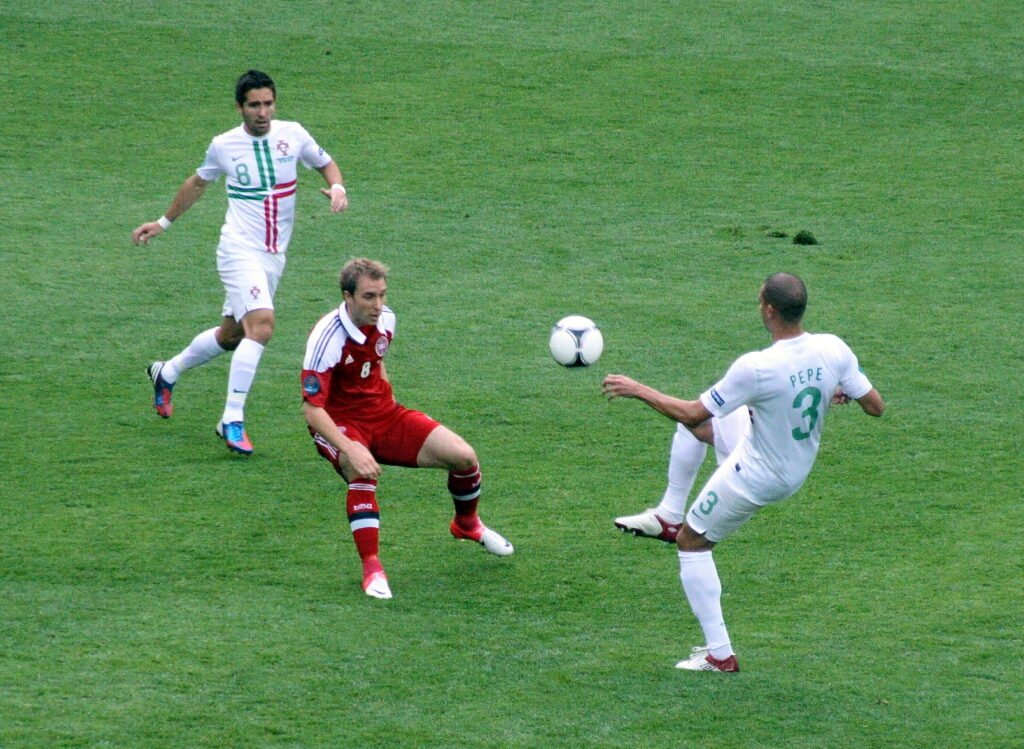
Historical match photograph: Denmark vs Portugal, UEFA Euro 2012, 13 June 2012. Photographer: User:Водник / Wikimedia Commons. Licensed under CC BY-SA 3.0. Original image and attribution.
The result in Braga
Estádio Municipal de Braga · 14 November 2026. UEFA match report.
The match: five goals, four decisive moments
The match took place at the Estádio Municipal de Braga on Saturday, 14 November. Denmark reached half-time with a one-goal advantage after Højbjerg converted a penalty in the 43rd minute. The visitors then struck twice in the opening stages of the second half: Højlund finished in the 49th minute and scored again in the 57th. Andersen’s 75th-minute header made it 4–0 before Silva scored for Portugal in added time.
That sequence matters. Portugal were not beaten by one isolated moment. Denmark scored immediately before the interval, widened the gap before Portugal could reset, and then added another goal after the home side had already been forced to chase the game. The late Portuguese goal changed the final score, not the direction of the contest.
UEFA’s matchday report described Højlund’s first goal as the finish to a move built by Gustav Isaksen. The second came from a low strike, while Andersen’s goal arrived from a set-piece delivery. The different types of goals underline Denmark’s variety: a penalty, a transition-style attacking move, a direct finish and a dead-ball threat.
Four Danish goals, one late response
Ronaldo’s retirement changed the context — not the responsibility
Ronaldo announced his international retirement on 5 November 2026, ending a Portugal career that FIFA records at 234 senior caps and 146 goals. He had represented the national team for more than two decades, captained it to UEFA EURO 2016 and helped it win the 2019 and 2025 Nations League titles. The announcement was therefore a major moment for Portuguese football, not simply the departure of a familiar forward.
Portugal marked the occasion in Braga. Reuters reported that the players wore Ronaldo’s No. 7 shirt during the pre-match tribute and that supporters displayed messages for the former captain. Carlos Forbs, who came on as a substitute, had been handed the No. 7 shirt for the new chapter. Those details gave the match a ceremonial layer that the scoreline quickly overwhelmed.
It would be too easy — and analytically weak — to argue that Portugal lost because Ronaldo was absent. He had announced his retirement, so the team had to begin adapting at some point. A single result cannot establish that the squad lacks leadership, that the tactical system depended entirely on him or that Portugal’s future is in decline. Those are broader questions that require evidence across a run of matches.
The more useful question is how Portugal distributes responsibility now. Ronaldo’s record included goals, penalty-box presence, leadership and the ability to turn a half-chance into a decisive moment. Those functions do not have to be reproduced by one player. They can be shared through the team’s attacking structure, the movement of the front line, the creative responsibility of the midfield and the leadership of senior players.
That redistribution takes time. The No. 7 shirt can pass to another player in an afternoon; the habits and expectations built around a generation-defining captain cannot be transferred in the same way.

Historical team photograph: Portugal and Denmark during the national anthems before their UEFA Euro 2012 match, 13 June 2012. Photo: Erik Cleves Kristensen / Wikimedia Commons. Licensed under CC BY 2.0. Original image and attribution.
Where Denmark found the advantage
1. Denmark made the critical moments count
The clearest difference was the timing of Denmark’s goals. Højbjerg’s penalty arrived just before the break, when Portugal had little time to respond before the dressing-room interval. Højlund’s two goals then landed within eight minutes of each other. That short burst changed the match from a one-goal contest into a difficult recovery job.
When a team concedes immediately after half-time, the next few minutes become especially important. The trailing side must decide whether to increase its attacking risk or protect its shape long enough to rebuild control. Portugal were pushed into a more urgent game state, while Denmark could defend with a lead and choose when to attack the space left behind.
2. Højlund gave Denmark a focal point
Højlund’s brace was the headline individual contribution. His first goal followed a promising Danish attacking sequence, and his second added to the pressure before Portugal had settled. A centre-forward who can occupy defenders, attack the penalty area and finish quickly gives a team a clear reference point when the game becomes stretched.
That does not make the performance a one-player story. Isaksen’s involvement in the first goal and the service that followed show why the quality of the supporting actions matters. The forward’s finishing completed moves that began elsewhere on the pitch.
3. Denmark threatened in more than one way
Denmark’s fourth goal came from a set piece, with Andersen heading home in the 75th minute. That mattered because it prevented Portugal from focusing only on open-play combinations. A side that can create danger from structured attacks and dead-ball situations gives the opponent more problems to solve.
For Portugal, the lesson is not simply “defend better”. The coaching staff will need to review the build-up to each concession: the decisions that allowed the penalty situation to develop, the reaction after half-time, the protection of the central area and the organisation around the set piece. Each goal has its own detail; grouping them together as a single defensive failure would hide the actual work required.
The key tactical reading
Editorial interpretation of the verified goal sequence; this panel is not a formation map or tracking-data visualisation.
What went wrong for Portugal?
The response after conceding was not strong enough
Top international teams are judged not only by how they start a match, but by how they respond when the plan is disrupted. Portugal needed a calm spell after Højbjerg’s penalty. Instead, Denmark scored twice early in the second half and forced the home side into a match defined by recovery rather than control.
That is an area for review: the first pass after winning possession, the distances between midfield and defence, the protection of the space in front of the centre-backs and the team’s ability to slow the opposition’s next attack. These are analytical questions prompted by the goal sequence, not claims about a specific formation or an individual player’s private instructions.
Leadership must become collective
Portugal still have experienced players and a deep talent pool. The challenge is to make leadership visible through the team’s behaviour: communication after a setback, composure when defending a lead or chasing a game, and the ability to keep standards consistent when the emotional tone changes. That responsibility belongs to the captain, senior players, coaching staff and the wider group.
It is also important not to place the whole burden on the new No. 7. Forbs’ shirt number is a symbol of succession, not a job description. Portugal do not need a replica of Ronaldo; they need a balanced attack in which goals, chance creation, pressing and leadership are shared according to the strengths of the players available.
Selection and structure need a clear identity
Portugal’s next step is to decide how the front line works together. Who stretches the last line? Who links play between midfield and attack? Who arrives in the box when the centre-forward drops? Who protects possession when the first attacking route is closed? A settled answer to those questions will matter more than trying to recreate the previous era through one direct replacement.
Generic coaching-analysis image. Photo: Mohameden beinbe / Pexels. Pexels License.
What the result means for Group A4
Portugal entered the match with four wins from four and had already secured a place in the quarter-finals. The 4–1 defeat did not remove that qualification; it reopened the contest for first place. After Matchday 5, Portugal remained on 12 points, Denmark moved to nine, Norway had six and Wales had three. One group match remained for each team.
The final fixtures were scheduled for 17 November: Wales against Portugal and Denmark against Norway. Under the 2026/27 Nations League format, the group winners and runners-up advance to the quarter-finals. Portugal’s immediate task was therefore to protect first place, while Denmark needed a strong final result and a favourable outcome elsewhere to finish top.
For supporters, that creates a more useful way to read the defeat. Portugal’s quarter-final place was secure, but the performance still mattered because it affected momentum, group position and the questions the coaching staff must answer before the knockout stage. Denmark, meanwhile, gained more than three points: it demonstrated that it can compete with a leading side away from home.
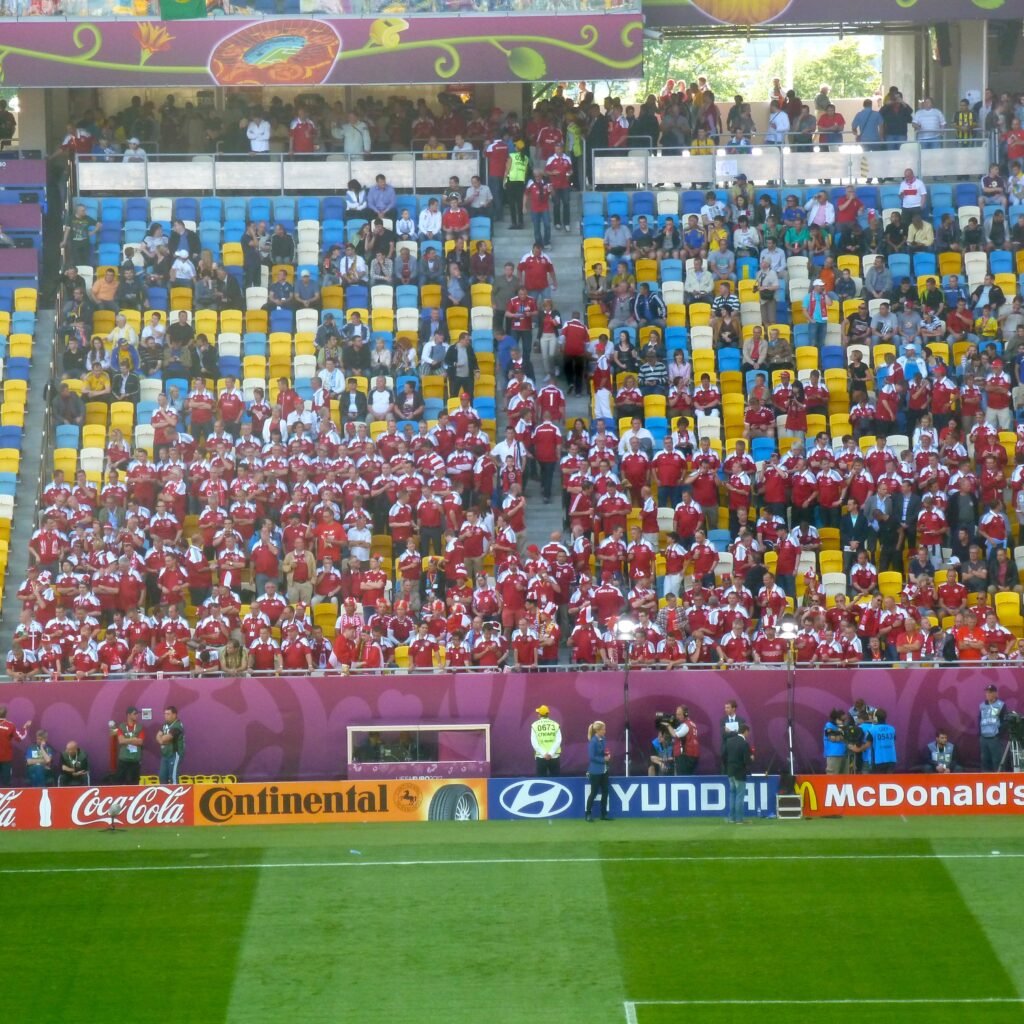
Historical supporter photograph: Denmark fans during UEFA Euro 2012, 13 June 2012. Photo: Erik Cleves Kristensen / Wikimedia Commons. Licensed under CC BY 2.0. Original image and attribution.
What should Portugal take into the next match?
The final group fixture is not a chance to erase the Denmark result with one headline performance. It is an opportunity to show that the team can learn quickly. Portugal should look for a more stable response after losing possession, clearer protection around the penalty area and better coordination between the first line of pressure and the midfield behind it.
In attack, the priority is to create repeatable patterns rather than depend on moments of individual brilliance. Portugal have players capable of receiving between the lines, running beyond the defence and delivering from wide areas. The coaching challenge is to connect those strengths so that the team can create chances even when the opponent denies its preferred route.
For Denmark, the next test is consistency. A 4–1 away win is a significant result, but it does not settle the group by itself. The team must carry the same defensive discipline and attacking clarity into the Norway fixture, where the stakes will be different and the opponent will prepare for the confidence Denmark gained in Braga.
For both nations, the final matchday will add context to what happened on 14 November. The most useful judgement of Portugal’s transition will come from a sequence of performances, not from treating one difficult night as a verdict on an entire generation.
Generic football action image. Photo: Israel Torres / Pexels. Pexels License.
The bigger picture: a new era needs more than a new No. 7
Denmark’s 4–1 win was deserved on the evidence of the decisive moments. Højbjerg’s penalty, Højlund’s double and Andersen’s header turned a high-profile occasion into a clear away victory. Portugal’s late goal softened the scoreline but did not change the main lesson: the team did not manage the periods immediately before and after half-time well enough.
Ronaldo’s retirement gives the result a wider meaning, but it should not become a shortcut explanation. Portugal’s next era will be shaped by how the team shares responsibility, builds a coherent attacking structure and responds when the game moves against it. The talent remains; the challenge is to organise it into a dependable collective identity.
That is the real story after Braga. Portugal have not lost their place among Europe’s leading teams, and one defeat does not settle the future. But the transition is now visible — and the work of defining it belongs to the whole squad.
Build better football decisions beyond the final score
Match analysis is one part of a wider development process. Nexathlon works across athlete development, talent scouting and football pathways for players, families, academies and clubs.
Frequently asked questions
What was the score between Portugal and Denmark on 14 November 2026?
Denmark beat Portugal 4–1 in Braga in the UEFA Nations League. Højbjerg scored a penalty, Højlund scored twice, Andersen added a fourth and Bernardo Silva scored Portugal’s late goal.
Who scored for Denmark against Portugal?
Pierre-Emile Højbjerg scored from the penalty spot in the 43rd minute, Rasmus Højlund scored in the 49th and 57th minutes, and Joachim Andersen scored in the 75th minute.
Was Portugal already qualified for the Nations League quarter-finals?
Yes. Portugal had already secured a top-two finish in Group A4 before the Denmark match. The defeat affected the race for first place, not Portugal’s quarter-final qualification.
Was this Portugal’s first match after Cristiano Ronaldo’s international retirement?
Yes. Ronaldo announced his international retirement on 5 November 2026. Portugal’s 4–1 defeat to Denmark on 14 November was the national team’s first match after that announcement.
Who wore Portugal’s No. 7 shirt after Ronaldo?
Carlos Forbs was handed the No. 7 shirt for the match against Denmark. The shirt number is a symbolic change; it does not mean that one player is expected to reproduce Ronaldo’s entire contribution.
When did Portugal play next in Group A4?
Portugal were scheduled to visit Wales on 17 November 2026. Denmark were due to face Norway on the same final group matchday.
Sources and further reading
- UEFA: Nations League Matchday 5 highlights and Portugal 1–4 Denmark report — primary competition reporting and goal sequence.
- Reuters: Denmark thrash Portugal 4–1 on night of Ronaldo tributes — independent match reporting and post-match context.
- FIFA: Cristiano Ronaldo calls time on Portugal career — retirement announcement and international career record.
- UEFA: 2026/27 Nations League fixtures and results by team — official Group A4 schedule.
- UEFA: Quarter-final qualification, promotion and relegation explained — competition format and qualification rules.
Editorial note: this article was researched on 15 November 2026. The match account and group position reflect information available after Matchday 5; the analysis is Nexathlon’s editorial interpretation, not a statement attributed to either national team.