
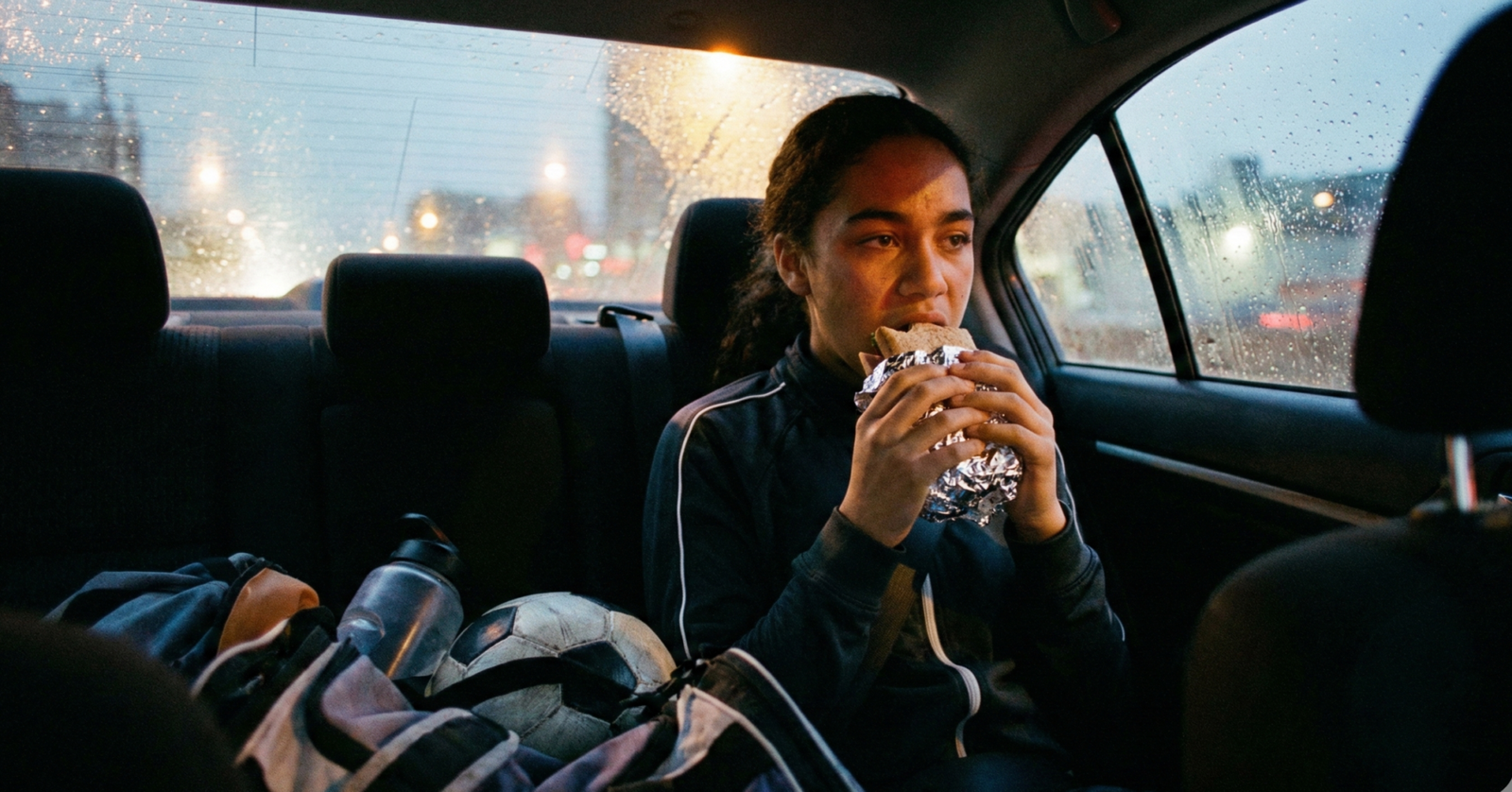
The Car Window Diet: Fuel for Youth Athletes
By The Nexathlon Strategy Team Estimated Reading Time: 8 Minutes
The 5:00 PM Panic
It is a scenario played out on highways in London, Mumbai, Dubai, and Madrid every single weekday.
You pick your child up from school. You have exactly 45 minutes to get them across town to the academy. Their uniform is in the trunk. They are tired, cranky, and starving. You are exhausted from work.
There, looming on the roadside like a beacon of salvation, are the Golden Arches. Or the local bakery. Or the gas station convenience store.
You make the calculation: “If they don’t eat, they’ll faint. A burger is protein, right? Better something than nothing.”
You hand the bag through the back window. They inhale the food. You drop them off at the pitch, feeling like you’ve solved the problem.
Here is the Radical Transparency check: You haven’t solved the problem. You have just handicapped your investment.
If you are spending $2,000 a year on academy fees, $300 on elite footwear, and weekends traveling for tournaments, but fueling that engine with high-fat, slow-digesting processed food 30 minutes before kickoff, you are effectively putting diesel in a Formula 1 car.
This isn’t about “bad parenting.” It’s about bad logistics.
At Nexathlon, we believe that high performance isn’t just about what happens on the grass; it’s about the infrastructure around the athlete. Today, we are going to fix your commute. Welcome to The ‘Car Window’ Diet.
The Biology of the “Commuter Slump”
Before we give you the shopping list, you need to understand the ROI (Return on Investment) of digestion. The “Investor Parent” needs to know why the drive-thru is killing performance data.
1. The Glycemic Index (GI) Clock
Not all calories are created equal, specifically regarding speed.
High GI Foods (Fast Fuel): Break down instantly. Glucose hits the bloodstream rapidly. (e.g., Sports drinks, ripe bananas, white bread/rice cakes).
Low GI Foods (Slow Fuel): Release energy over hours. (e.g., Oats, whole grains, yogurt).
The Mistake: Feeding a child High GI foods (candy) 3 hours before practice leads to a sugar crash right when the whistle blows. Feeding a child Low GI/High Fat foods (burgers, pizza) 30 minutes before practice means the energy won’t be available until they are back in the car driving home.
2. The Blood Flow War
Digestion is an energy-expensive process. When your athlete eats a heavy meal (high protein/high fat), the body diverts blood flow to the stomach to break it down.
When they start running, the muscles scream for that same blood to deliver oxygen.
The Result: The stomach cramps (because digestion stops) and the legs feel heavy (because oxygen is limited).
The Metric: If your child looks sluggish in the first 20 minutes of training, it’s rarely a lack of fitness. It’s usually active digestion.
The Strategic Shift: The Glovebox Pantry
You don’t need a nutritionist on staff. You need a logistical system. We call this The Glovebox Pantry.
The goal is to remove “decision fatigue” from your commute. By stocking the car with non-perishable, high-performance options, you eliminate the need for the drive-thru.
Category 1: The “Emergency” Stash (Non-Perishable)
Keep these in a dedicated box in the trunk or glove compartment. They survive heat and cold and are ready for the days you forget everything else.
Rice Cakes (Plain or Lightly Salted):
Why: Pure, fast-digesting carbohydrates. It’s like rocket fuel for the muscles without the heavy stomach feel.
The Upgrade: Squeeze a honey packet (stolen from a coffee shop or bought in bulk) on top.
Dried Fruit (Dates, Figs, Apricots):
Why: Nature’s energy gel. Dates have a high glucose content that hits the system fast. Two Medjool dates provide enough energy for a 60-minute intense session.
Pretzels:
Why: Sodium + Carbs. Athletes lose salt when they sweat. Pretzels replenish electrolytes and fuel glycogen stores simultaneously.
Honey Sticks:
Why: The oldest performance enhancer in history. A straight shot of glucose.
Category 2: The “Cooler Bag” Rotation (Perishable but Portable)
If you are organized enough to pack a bag in the morning, these are the gold standard for the “Car Window” hand-off.
The PB&J (The G.O.A.T.):
Why: It is the perfect ratio. White bread (fast carb), Peanut Butter (satiety/protein – use sparingly right before games), Jelly (fast energy).
Nexathlon Tip: Cut it into quarters. Eat two quarters 45 minutes out. Save the rest for post-game recovery.
Chocolate Milk (Tetra Pak):
Why: Often called the perfect recovery drink, but excellent for pre-game hydration and energy if consumed 60 mins prior. It has the ideal carb-to-protein ratio.
Banana:
Why: The classic. High potassium (prevents cramping), comes in its own wrapper, easy to digest.
Warning: Do not leave these in the car on a hot day. The smell will never leave.
Category 3: The “Smart” Gas Station Stop
Sometimes, you just can’t prep. You have to stop. Here is how to navigate the convenience store aisle like a Scout.
BUY THIS:
Fig Newtons / Fig Bars (Dense carbs).
Pretzels.
Chocolate Milk.
Plain Granola Bars (Look for “Oats and Honey” rather than “Chocolate Chip Dipped”).
AVOID THIS:
Hot Dogs/Sausage Rolls: These are “Grease Bombs.” They will sit in the stomach for 4 hours.
Candy Bars (Snickers/Mars): This is a sugar spike followed by a crash. Plus, the fat content slows down the sugar absorption, making it the worst of both worlds for immediate energy.
Energy Drinks (Red Bull/Monster): For a 14-year-old? Absolutely not. The caffeine jitters will ruin their touch and decision-making capabilities.
The “Timeline” Strategy
The “Investor” Parent understands that timing is the variable that changes the outcome. Here is your schedule:
The 3-Hour Window (Lunch/After School Snack)
Goal: Sustained Energy base.
The Menu: Chicken wrap, pasta salad, oatmeal, turkey sandwich on whole wheat.
The Logic: Mixed macronutrients (Carbs + Protein + little Fat).
The 60-Minute Window (The Car Ride)
Goal: Top off the tank without flooding the engine.
The Menu: Banana, Rice Cake with Honey, half a bagel.
The Logic: Mostly Carbs. Low Protein. Low Fat. Low Fiber (fiber causes bloating during running).
The 15-Minute Window (Putting boots on)
Goal: Brain alertness and hydration.
The Menu: 200ml Water. Perhaps a few gummy bears or a slice of orange.
The Logic: Mouth rinse. Just enough sugar to wake up the brain, not enough to trigger an insulin spike response.
Nexathlon Insight: The “Hydration Gap”
The Reality Check
Here is a data point from our scouting combines: 70% of youth athletes arrive at training already in a state of dehydration.
They have sat in classrooms all day, perhaps drinking one soda at lunch. They get in your car, which has the AC blasting (dehydrating air). They eat a dry granola bar. They run for 90 minutes.
The Symptom: Loss of focus, irritation, “tired legs,” and perceived lack of effort.
The Car Window Fix: The moment they enter the car, the water bottle opens. It’s not optional.
The Rule: “The bottle must be empty before we park.”
If they don’t like water? Add a splash of fruit juice or an electrolyte tablet (low sugar).
Do not rely on the academy water fountain. It might be broken, or the line might be too long. Control the variable.
B2B Angle: The Academy Opportunity
For the “Entrepreneurial” Coach reading this.
If you run an academy, you know that parents struggle with this. You see the kids showing up with McDonald’s bags. This is hurting your training session quality.
The Solution: Monetize the convenience. Set up a “Fuel Station” at your check-in desk. Sell bananas, apples, and reputable energy bars at cost (or a slight margin).
Value Add: You aren’t just selling a snack; you are ensuring your athletes are physically capable of executing your drills.
Branding: “We fuel champions here.” It differentiates you from the club down the road that doesn’t care what the kids eat.
Conclusion: The True Cost of a Burger
Let’s look at the math one last time.
Option A (The Default):
Fast Food Meal: $8.00
Nutritional Value: High Saturated Fat, High Sodium.
Performance Outcome: Sluggishness, dehydration, reduced training adaptation.
ROI: Negative. You wasted the training session fee.
Option B (The Car Window Diet):
Banana + Pretzels + Water from home: $1.50
Nutritional Value: Electrolytes, Glycogen, Hydration.
Performance Outcome: High energy, sharp focus, better recovery.
ROI: Positive. You maximized the training session.
As a parent, you are the Chief Logistics Officer of your child’s athletic career. You cannot always control if the coach plays them, or if the referee makes a bad call. But you can control the fuel that goes into the tank.
Don’t let a $5 snack compromise a $5,000 season.
Ready to benchmark your athlete’s true potential?
Nutrition is just one pillar of the “Invisible Game.” At Nexathlon, we assess the total athlete—technical, physical, and cognitive. [Click Here to Schedule a Nexathlon Scouting Assessment] and see where you truly stand on the global stage.
"This showcase was a beautiful reminder of the power of dedication, artistry, and teamwork in rhythmic gymnastics. Each performance celebrated our athletes' hard work and the passion that fuels our community. Together, we’re inspiring the next generation to reach new heights."