
Smartphone Scouting: The Data-Driven Guide to Fixing Technique with AI Video Analysis
Author: Nexathlon Strategy Team Category: Coaching Technology & Scouting Reading Time: 8 Minutes Target Audience: Entrepreneurial Coaches, Academy Owners, Aspirational Athletes
"This showcase was a beautiful reminder of the power of dedication, artistry, and teamwork in rhythmic gymnastics. Each performance celebrated our athletes' hard work and the passion that fuels our community. Together, we’re inspiring the next generation to reach new heights."
The “Naked Eye” Fallacy in Modern Coaching
For decades, the standard for correcting a young athlete’s technique—whether it’s a cricket fast bowler’s delivery stride or a footballer’s free-kick stance—was the coach’s “experienced eye.”
Here is the hard truth: The human eye operates at roughly 30 to 60 frames per second (FPS). A fast bowler’s front foot contact lasts milliseconds. The torque on a pitcher’s elbow happens faster than a blink.
If you are an academy owner or a serious coach relying solely on what you think you see, you are guessing. And in the high-stakes world of youth development, guessing leads to two things: stagnated performance and preventable injury.
At Nexathlon, we believe in Radical Transparency. The days of needing a $50,000 biomechanics lab to analyze an athlete are over. By 2026, the supercomputer in your pocket—your smartphone—combined with accessible AI applications, has democratized elite-level scouting.
This article isn’t about buying expensive gadgets. It is about how to use the tool you already own to turn “opinion” into “data.”
The Technology: Demystifying “Pose Estimation”
You don’t need to be a data scientist to understand how this works. The core technology driving the revolution in smartphone scouting is called AI Pose Estimation.
How it Works
Input: You record a video of the athlete using your standard smartphone camera (120 FPS or 240 FPS slow-motion modes are standard on most mid-range phones in 2026).
Processing: An AI algorithm scans the video frame-by-frame. It identifies key anatomical landmarks: the ankle, knee, hip, shoulder, elbow, and wrist.
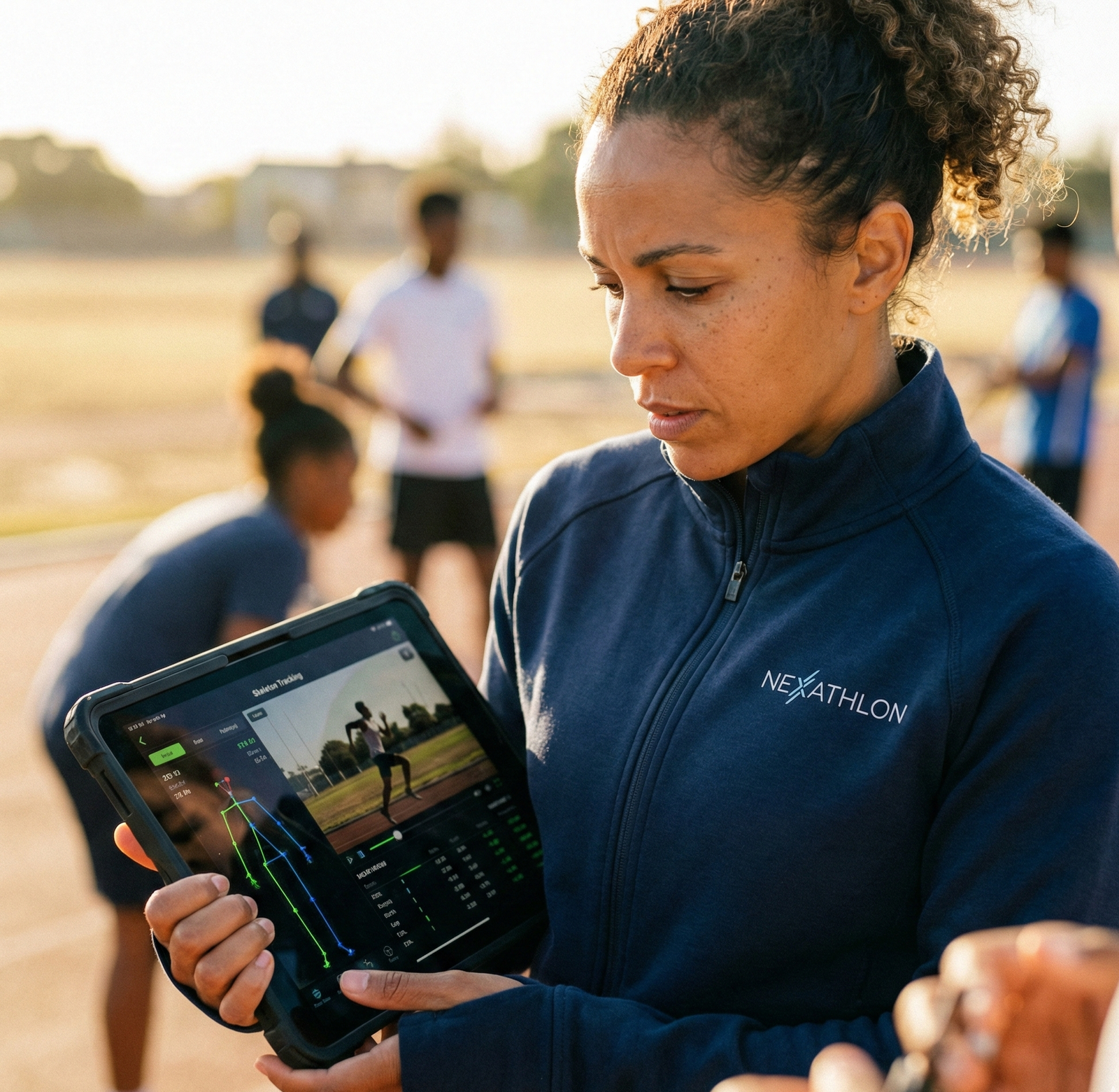
Output (The Skeletal Overlay): The app draws a digital “skeleton” over the athlete. As the athlete moves, the skeleton moves.
The Metrics: Because the AI knows the distance between these points, it can instantly calculate angles, velocity, and acceleration.
Why this matters: A coach might say, “Your arm is too low.” The player might argue, “It feels high.” The AI says: “Your release angle is 15 degrees below the optimal vertical line.” Data ends the argument.
Case Study 1: The Cricket Fast Bowler (Fixing the Action)
Let’s apply this to one of the most technically complex movements in sports: the cricket bowling action. This is where the “Missing Middle” of talent often gets stuck—they have pace, but they leak energy or risk stress fractures.
The Problem: The “Mixed Action”
A common flaw in young bowlers is a “mixed action”—where the lower body is side-on, but the upper body is front-on. This twisting of the spine (counter-rotation) is the number one cause of lumbar stress fractures in cricketers under 18.
The Smartphone Solution
Step 1: The Setup
Camera Position: Place the phone on a tripod (or have a steady hand) exactly perpendicular to the pitch (side-on view) or directly behind the stumps (back view). Height should be at the athlete’s hip level.
Frame Rate: Switch your camera settings to Slow Motion (240 FPS). Standard video blurs the arm at high speeds.
Step 2: The Capture
Have the bowler deliver 6 balls. Do not coach them yet. Just capture the baseline data.
Step 3: The AI Analysis (The Skeletal Overlay)
Upload the clip to an analysis app (e.g., Dartfish, OnForm, or specialized cricket AI tools).
Look for the Angle of Release: The AI will draw a line from the hip to the shoulder and the shoulder to the wrist.
Look for the Knee Angle: Freeze the frame at “Front Foot Contact.” The AI will show the angle of the front knee. Is it bracing (180 degrees) or collapsing (bending under 140 degrees)?
The Visual Evidence: Imagine seeing your bowler on screen. Overlaid on their body is a neon green stick figure. A red alert flashes at the knee joint showing “135°”.
The Insight: A collapsing knee means energy is leaking into the ground rather than transferring into the ball. The bowler isn’t just “tired”; they are biomechanically inefficient.
The Fix
Instead of telling the bowler “stand tall,” you show them the video. You set a goal: “Let’s get that red 135° number up to a green 160°.” Now, the athlete has a quantifiable target. They are gamifying their own biomechanics.
Case Study 2: The Football (Soccer) Striker (The “Lean” Factor)
Goal-scoring often comes down to the physics of body shape. A common complaint from coaches is that a young player “skies” the ball over the crossbar during set pieces or long-range efforts.
The Problem: Lean-Back Mechanics
Players often naturally lean away from the ball to generate lift, but excessive backward lean (hyperextension) causes the foot to strike under the ball, sending it too high and sacrificing control.
The Smartphone Solution
Step 1: The Setup
Camera Position: Side-on, aligned with the ball.
Frame Rate: Slow Motion (120/240 FPS).
Step 2: The AI Analysis
Freeze Frame: Pause at “Ball Impact.”
Torso Angle: Measure the line of the spine relative to the vertical axis.
Plant Foot Position: Distance of the non-kicking foot from the ball.
The Insight: Ideally, the chest should be “over the ball” (a forward or neutral angle). If the AI skeleton shows a -20° backward lean, physics dictate the ball will rise uncontrollably.
The Fix
Show the player the overlay. “We need to move your spine angle from -20° to 0° (vertical) at impact.” The visual feedback instantly corrects the proprioceptive error.
Case Study 3: The Sprinter (The “Drive Phase” Mistake)
In athletics, the race is often lost in the first 10 meters. For developing sprinters, the transition from the blocks is the hardest phase to master.
The Problem: “Popping Up”
Novice sprinters instinctively try to stand upright too quickly after leaving the blocks. This kills their acceleration mechanics and introduces wind resistance too early.
The Smartphone Solution
Step 1: The Setup
Camera Position: Low angle (knee height), side-on, capturing the first 5–10 meters.
Step 2: The AI Analysis
Shin Angle: Measure the angle of the shin relative to the track as the foot strikes the ground.
Trunk Angle: Measure the spine relative to the track.
The Insight: Elite acceleration requires a “positive shin angle” (roughly 45°) and a low body position. If the AI shows the athlete is upright (80–90°) by step three, they have exited the “Drive Phase” prematurely.
The Fix
Use the skeletal lines to visually force the athlete to “stay low” until the 20m mark, keeping their shin angles acute to drive back into the track, not down.
The Protocol: Implementation for Academies
If you are an “Entrepreneurial” Coach struggling with overheads, you don’t need to hire a full-time biomechanist. You need a protocol. Here is how you monetize this:
1. The “Benchmarking” Product
Stop selling “coaching sessions.” Sell a “Quarterly Biomechanical Audit.”
Every 3 months, every student gets filmed.
They receive a PDF report showing their key angles (Knee Flexion, Arm Release, Hip-Shoulder Separation).
Value Proposition to Parents: “We don’t just guess your child’s progress; we track their structural integrity.”
2. The Remote Coaching Model
Allow students to send you videos from their backyard or local park.
You run the AI analysis remotely and send back a voice-over breakdown.
Result: You scale your coaching business beyond your physical location.
3. Injury Prevention (The Trust Builder)
Use the data to stop bowling. If a bowler’s action degrades (angles drop) due to fatigue during a session, the data tells you when to pull them out.
Parental Anxiety Relief: You are proving that you care about the child’s long-term health, not just winning the next match.
The Reality Check: Nexathlon Insight
We believe in Radical Transparency. Here is what the app developers won’t tell you.
1. 2D is NOT 3D A smartphone camera sees in two dimensions (flat). If a bowler angles their run-up slightly toward the camera, the AI’s math will be skewed by “parallax error.”
The Fix: You must be rigorous about camera angles. If you aren’t perfectly side-on, the data is just an estimate, not a fact.
2. Data Paralysis Do not bombard a 14-year-old with 20 different data points. It will cause “analysis paralysis.”
The Coach’s Job: The AI provides the data; you provide the filter. Pick one metric to fix at a time (e.g., “This week, we only care about the front arm”).
3. Lighting Matters AI vision struggles in low light or indoor nets with flickering fluorescent bulbs.
The Fix: Film outdoors in natural light whenever possible for the most accurate skeletal tracking.
Conclusion: The New Standard of Verification
The sports market is flooded with promises. “We will make you a pro.” “We have the best coaching.”
At Nexathlon, we don’t make promises we can’t measure. The future of scouting and development isn’t about who shouts the loudest; it’s about who has the data to back it up.
For the aspirational athlete: Demand to see your data. If your coach can’t show you why you are losing speed, find one who can. For the academy owner: Implement this technology today. It is the lowest-cost, highest-value differentiator available in 2026.
Don’t Just Guess Your Talent Level.
Are you training efficiently, or are you reinforcing bad habits? Get Benchmarked. Book a Nexathlon Scouting Assessment today and get your comprehensive Biomechanical Profile.